B.S. in Communication splits into four majors to better serve students
By Tricia Booker
Instructor, Multimedia Journalism

John Meeks was an introverted soul in high school who found it difficult to communicate verbally. But he found a way to express himself: He began an underground newspaper that he wrote by hand and copied off surreptitiously in the Orange Park High School media center.
Now, three decades later, both verbal and written communication have become a part of Meeks’ identity. He has been a history teacher at Mayport Middle School for 23 years, and he also serves as head of the school’s gifted and talented program. Additionally, he’s Teacher First Vice President of Duval Teachers United (AFT Local #3326) and served on both the Florida Education Association Governance Board and the National Education Association Resolutions Committee.
Meeks graduated from UNF in 1998 with a degree in communication and concentration in print journalism. As a student, he was news editor of the Spinnaker. The best part of that, he said, was writing reviews of the amazing concerts he attended. “I will always remember the Green Day and Alanis Morissette shows,” he said. “I still have clippings of my various reviews in my home archives.”
His obsession with the news began at a young age; he regularly read the Florida Times-Union and the New York Times. At age 17, he wrote his first letter to the editor, commenting on the 1992 presidential election. “It was out of frustration that I did not turn 18 until after the election and that, although I could not vote, there were eligible voters who chose not to exercise their right to vote,” he said. “That election was memorable because I felt empowered to use my voice in any way that I could.”
Eventually, his career journey took him to teaching. But he still uses his communication skills. “I believe that my work in print journalism has helped me to become a better writer with regards to writing lessons and assessments, communicating with families, and incorporating writing skills into social studies,” he said. “I also bring public relations and advertising experience that helps with promoting my school in the media.”
Teaching history effectively, in particular, requires a unique ability to connect with students. “I think that teaching history has progressed beyond memorizing and regurgitating dates, and I want to take it beyond what has been seen as a boring topic as well,” he said. “When we tell the story of our nation in my class, I want to make history relevant by applying past issues to today.”
Recently, Meeks received a diagnosis of ADHD - late diagnoses of the disorder runs in his family. In hindsight, he said, he can see how his younger self tried to mask symptoms in order to fit in. But learning about it now is helping him understand more about himself. “(It) will bring me answers that are long overdue,” he said.
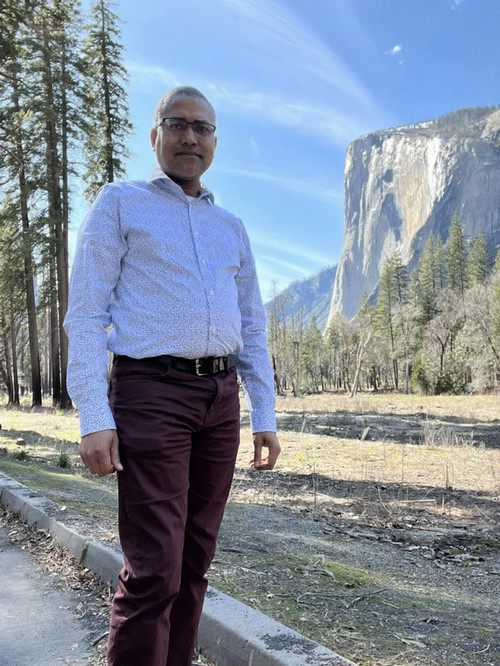
When he’s not teaching students and taking care of union business, Meeks loves to travel. Two years ago, he gifted himself a trip to California for his 50th birthday, and did a pilgrimage to Naval Station Lemoore, where he was born, before traveling the Pacific Coast Highway. “For me, this was a spiritual journey that left me feeling reconnected and at peace,” he said.
By Tricia Booker
Instructor, Multimedia Journalism

For years, the School of Communication has taught students how to produce quality media material ranging from marketing ads to digital journalism. Now it is building a lab to measure the effectiveness of those products.
The Digital Media + AI Innovation Lab, or DMAIL, had a soft launch last fall under the careful guidance of Dr. Rachel Riggs Achorn and Dr. Sydney Brammer, School of Communication assistant professors specializing in public relations and mass communication, respectively.
“DMAIL is dedicated to investigating phenomena related to digital media, new and emerging media, and artificial intelligence through a variety of methodological approaches,” Brammer said. “In other words, if you build it and bring it to us, we can tell you if it works.”
The lab is open to faculty and students seeking to evaluate their research or the effectiveness of their marketing and advertising strategies. But Brammer and Achorn also hope local communication professionals will be interesting in using it and perhaps collaborating with the School of Communication. “We’re currently conducting several pilot projects,” Achorn said. “But we’re also pursuing grant funding to support growing the lab, and we are seeking community partners who would like to brainstorm potential avenues for community-engaged research.”
Brammer and Achorn both earned their PhDs in Texas, where they met, and were inspired to start DMAIL after learning about the Texas Tech Center for Communication Research. The cost of DMAIL has been funded by both the School of Communication and the UNF College of Arts and Sciences, with more purchases coming soon to complete the lab.
As technology evolves, the lab’s capabilities will change as well. Learning about how to use the software and equipment will require ongoing training. Most recently, both Brammer and Achorn learned how to use the Perception Analyzer DialSmith, which can collect real-time data about viewers’ perceptions of media messages.
“Our students at UNF produce amazing media products like news reels, social media content, and more,” Achorn said. "We wanted to provide an opportunity for them to test the effectiveness of those media messages and understand the importance of audience and storytelling when crafting and producing media products and media content.” More information can be found on the lab’s website.

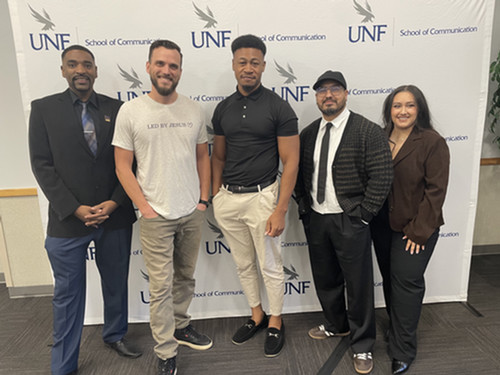
SMEJ presenters included (left to right) Frank Goodin, Stephen Freeman, Marquis Thornton, Chris De La Cruz, and Ashley Aguilar.
At a time when social media is being blamed for an epidemic of loneliness, the School of Communication’s annual Social Media Expo JAX (SMEJ) continues to emphasize the importance of human connection in the success of digital communication.
The event, co-planned by Dr. Margaret Stewart, a School of Communication associate professor and expert on strategic communication and social media strategy, attracted social media managers, content creators, and entrepreneurs in health care, legal, education, and corporate business.
SMEJ is organized to hit upon the newest trends in the industry, and the theme of the October 2025 event focused on digital video, which has become a necessity for nearly all forms of marketing and communication. Five presenters delivered 30-minute flash sessions to share practical information and tactical strategies about creating and incorporating digital video into strategic social media. Several presentations emphasized the influence of artificial intelligence (AI) on digital media production and social media strategy.

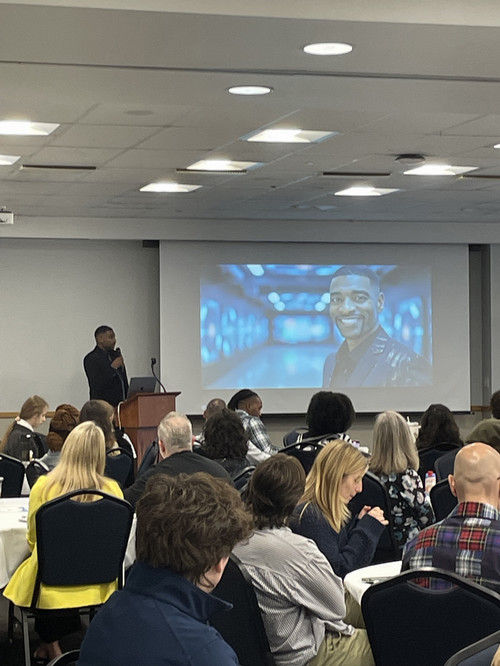
Carbon-based Frank Goodin and his alter ego, “AI Frank,” spoke to a sold-out SMEJ.
Each presentation provided a tool, formula, or technique for attendees to test out or utilize upon leaving the event. Frank Goodin, an associate instructor of digital video production in the School of Communication, reinforced the principle that social media is centered around people engaging with one another. “Successful digital media is human-led and AI-enabled,” he said. While the digital and AI components are critical, they can’t be effective without people, he added.
The 2025 SMEJ welcomed a new collaborating partner: Jacksonville-based Kairos Digital. Kairos leader and founder Stephen Freeman is a UNF alum and was featured as one of the Jacksonville Business Journal’s “40 under 40” in 2024.
The seventh annual SMEJ is planned for Oct. 23, 2026, and will offer a workshop focused on digital brand voice.

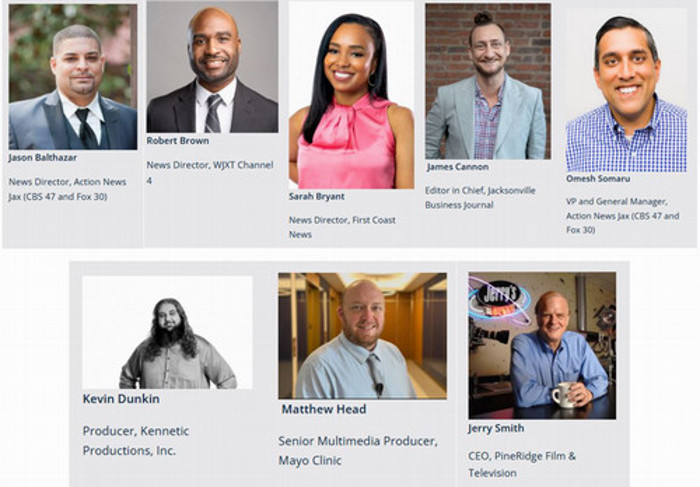
To keep up with industry trends, the School of Communication has recently grown the multimedia journalism and digital video production sections of the Professional Advisory Board. The new journalism members include executives at local news outlets:
Jason Balthazar, News Director of Action News Jax (CBS and Fox)
Robert Brown, News Director of WJXT Channel 4
Sarah Bryant-Holcomb, News Director for First Coast News (ABC and NBC)
James Cannon, Editor in Chief, Jacksonville Business Journal
Omesh Somaru, VP/General Manager of Action News Jax (CBS and Fox)
The new digital video production members represent the wide range of jobs in corporate, documentary, and narrative production:
Kevin Dunkin, Producer for Kennetic Productions
Matthew Head, Senior Multimedia Producer, Mayo Clinic
Jerry Smith, CEO, PineRidge Film & Television
Board members meet annually with our faculty to review the curriculum and make suggestions. Members also participate in our Media Week and internship fair events. A full list of members is on our Professional Advisory Board website.
Dr. Christa Arnold and Dr. Stephynie Perkins presented “Highlighting the voices of African Americans in 1968: Telling stories of black and white in the editorial pages of black newspapers to elevate community understanding” at the National Communication Association.
Dr. Junga Kim won a grant from The Florida Blue Center for Ethics for a project, titled “Understanding generative AI dependency and anxiety among college students.”
Dr. Chunsik Lee and Dr. Junga Kim won a grant from the UNF COAS Dean’s Leadership Council for a project, titled “Generative AI literacy and responsible AI uses.”
Dr. John Parmelee and Dr. Nataliya Roman presented “Does AI have a ‘moral empathy gap’? Examining how AI chatbots morally reframe political issues” at the Association for Education in Journalism and Mass Communication. Roman and Parmelee also presented “‘The architect of the invasion’ vs. ‘a symbol of resilience’: How AI chatbots frame Zelenskyy, Putin and the Russia-Ukraine war” at AEJMC.
Dr. Nataliya Roman and Dr. John Parmelee published “Memory of the multitude and representation in AI-generated images of war” in Memory, Mind & Media.
Dr. Stephynie Perkins presented “Beyond the gates: Elevating ‘Black Royalty’ through daytime drama” at the National Communication Association.
Dr. Rachel Riggs presented “‘With friends, it’s harder to have a serious conversation’: Expectations of youth when disclosing mental health concerns with peers" at the National Communication Association.

If you want to get more involved, there are eight great ways to stay connected with the School of Communication, including participating in our annual Media Week event and Internship + Job Fair, and contributing an alumni profile.
The board helps us make sure we are getting students prepared for the current media environment. If you have risen to a position of leadership at a news organization, PR firm, advertising agency or other media outlet, please contact the school's director, John Parmelee. Even if you don't want to be on the board, feel free to email the director with any advice on making the curriculum better.
This is a great chance to interact with fellow communication alumni and current students. To join, please contact the School's Alumni Association, mention your interest in joining, and please include your name, contact information, year of graduation and track. Also, all communication alumni are invited to be a part of the conversation on Facebook. This is the "go to" spot for UNF communication alumni. The Facebook group includes information about alumni social events, recently posted communication jobs, tech tips, departmental news, and pictures/video from school events such as Media Week. In addition, communication faculty members have joined the group, so you can connect with your old professors. Here's how to join the alumni Facebook group: Search for UNF communication alumni and ask to join.
Below is a link that lists faculty and their email addresses. Faculty love to hear what their former students are up to and are always happy to offer advice.
Every spring, representatives from companies such as WJXT, the Florida Times-Union, United Way and Mayo Clinic meet with communication students to discuss upcoming internships and jobs. If you are a leader at a company that is looking for interns to do advertising, public relations, journalism or production, please contact professor Bobbi Doggett to participate.
Your expertise in advertising, public relations, journalism or production could be a real benefit to current students. We are always looking for guest speakers to come to communication classes. A good time to do this is during the fall semester when the school hosts Media Week, an opportunity for media professionals to speak with students and faculty about the media landscape. Contact John Parmelee for more information. If you want to mentor our students, please fill out a profile on our mentoring website.
This is your chance to let faculty and fellow alumni know of any big career or personal changes in your life. Also, consider contributing a 300- to 500-word piece on which professors made the biggest impact on your career. Submissions will be published in the alumni newsletter. Contact John Parmelee to submit.
Even a small gift can help us enhance our facilities, academics and recruiting of top-quality students and faculty. To contribute, please go to our website.

Dr. Brian Thornton, a professor of mass communication, died on Oct. 28, 2025. Before coming to UNF in 2007, Thornton had served as a professor in Illinois and Texas. Hundreds of students over the years have enjoyed his courses, which include MMC 3200-Law & Ethics of Communication, MMC 4420-Mass Communication Research, and MMC 4500-History of Mass Communication. His research area was in journalism history.
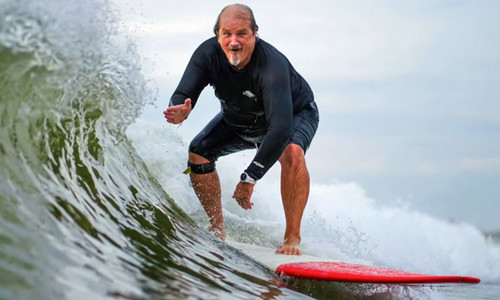
Thornton was an avid surfer and member of a blues band.
A memorial tribute to Thornton is available on YouTube: