UNF graduate students shine at 2026 Conference of Florida Graduate Schools
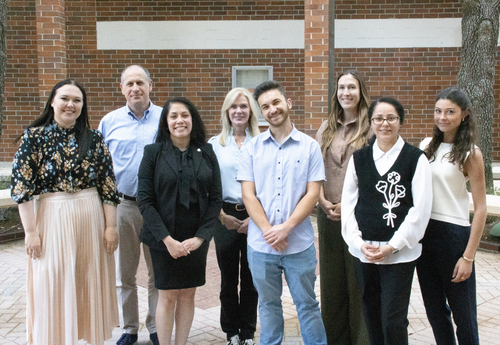
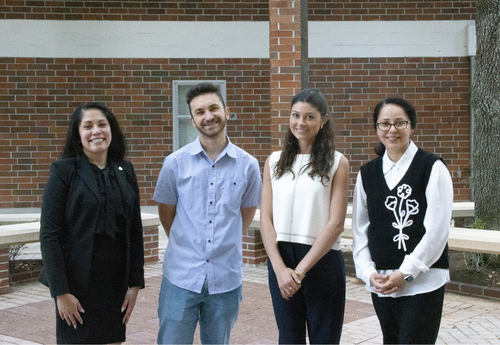
This spring, four University of North Florida graduate students represented UNF at the 2026 Conference of Florida Graduate Schools (CFGS), hosted by the University of Florida in Gainesville. Centered around the theme "Future-Focused Leadership: Supporting Staff, Empowering Students and Advancing Research and Innovation in Graduate Education," the conference brought together graduate students, faculty and staff from institutions across the state to share research, explore innovations in graduate education and strengthen cross-institutional collaboration.
"Opportunities like CFGS allow our graduate students to share impactful work, build confidence as scholars and engage with peers and faculty from across Florida," said Dr. Michele Moore, dean of The Graduate School.
A Stage for Student Research
The CFGS Poster Presentation gave graduate scholars the opportunity to share their work with peers, faculty and professionals from universities across Florida — for many, their first time presenting at a statewide academic conference.
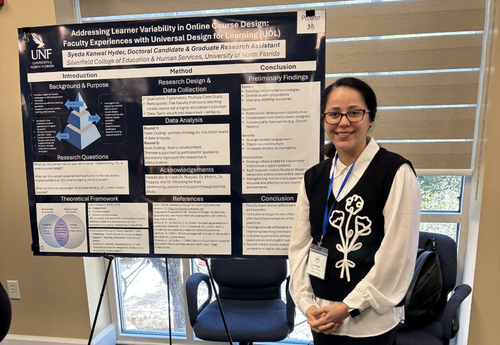
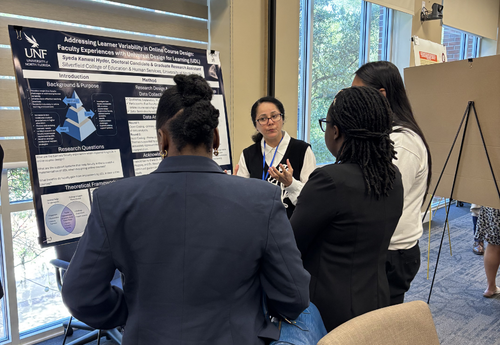
Syeda Hyder, an Ed.D. student, presented research focused on how faculty design online courses to support students with different learning needs through Universal Design for Learning (UDL) principles. Her work explores how institutions can better support faculty in creating accessible and inclusive learning environments. For Hyder, being selected to present carried real significance. "It was meaningful because it validated the importance of my work and allowed me to share my research with a broader academic audience," she said. "Faculty often recognize these needs but lack the support, training and time to translate them effectively into course design."
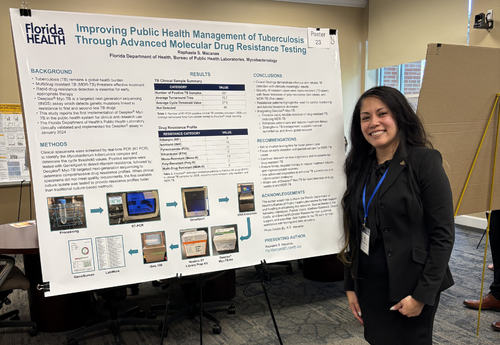
Raphaela Macanas, a Master of Public Health student, presented research on a disease many assume is a problem of the past but isn't. Tuberculosis remains an active public health threat and in Florida, slow diagnosis is a significant barrier to controlling it. Traditional culture methods can take six to eight weeks to identify drug resistance; Macanas's research uses next-generation sequencing to cut that delay dramatically, enabling faster, more targeted treatment. "Rapid detection of drug resistance is key to enabling timely, targeted TB treatment and improving overall disease control," she said. Feedback from conference attendees — particularly international PhD students — underscored that the stakes extend well beyond Florida.
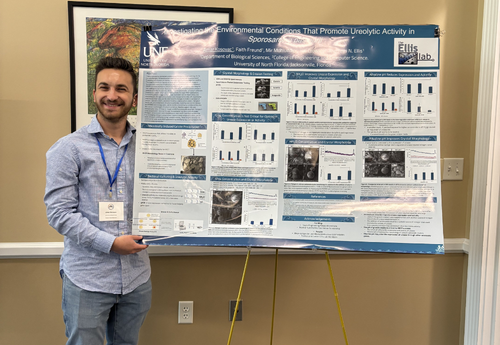
Amar Kosovac, a Biology graduate student, took the conference stage with research that hits close to home for Floridians: protecting the state's critically eroded coastline using bacteria. His work focuses on optimizing the production of a key enzyme that binds sand particles together — a potentially scalable, nature-based solution to a problem that threatens nearly 500 miles of Florida's shoreline. Presenting to researchers from across disciplines proved unexpectedly valuable. "It was so cool to receive feedback from people who are non-microbiologists," Kosovac said. "They provide feedback that is outside of the box — something we would never consider."
Three Minutes, One Chance: The 3MT Competition
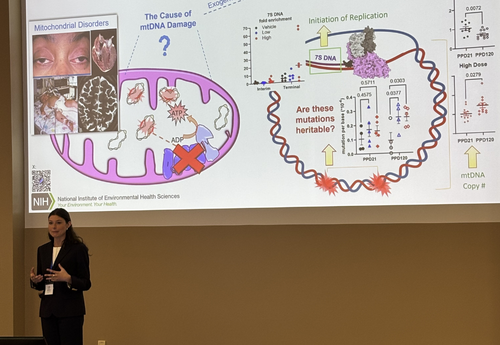
Biology graduate student Sophia Cochran took on one of the conference's most demanding challenges: the Three Minute Thesis (3MT) competition. Competitors have just three minutes — and a single static slide — to communicate the significance of their research to a general audience. No notes. No props. Just clarity, passion and precision.
Cochran's research centers on mitochondrial stability of the genome, with a long-term vision of expanding into DNA replication and its implications for understanding neurological and developmental disorders. "Presentations can feel intimidating," she said. "It is important to switch the mindset from viewing presentations as a performance to seeing them as a way to share the importance of your work."
Collaboration Beyond Student Research
In addition to student presentations, staff from The Graduate School attended professional development sessions and connected with graduate education leaders from institutions across Florida. Stephanie Urbas, Director of Operations, presented during the conference's "Lightning Rounds: Best of Florida Graduate Education" session, highlighting recent innovations at UNF to streamline admissions processes involving committee reviews. Sessions also covered student engagement, mentorship, leadership development, burnout prevention and strategic planning.
Looking Ahead
For each of the four students, the experience was more than a line on a CV. It was a moment of connection — with peers, with the broader academic community and with the possibilities that lie ahead.
"These experiences are incredibly important because they help students build interdisciplinary connections, strengthen their communication skills and see how their research can create meaningful impact in their fields and communities," said Dean Moore. "It is equally valuable for our Graduate School team to participate alongside them — conferences like CFGS create opportunities for us to collaborate with peer institutions, exchange ideas and explore innovative approaches that help us better support graduate student success and academic innovation at UNF."