
From classroom concepts to citywide impact: UNF graduate student turns data into public good
April 29, 2026
When Sneha Kattari enrolled in the Master of Science in Computer and Information Sciences program at the University of North Florida, she was looking for more than a credential — she was looking for a place to build something real. This May, she graduates having done exactly that, contributing to a live, public-facing data platform that serves the residents of Jacksonville.
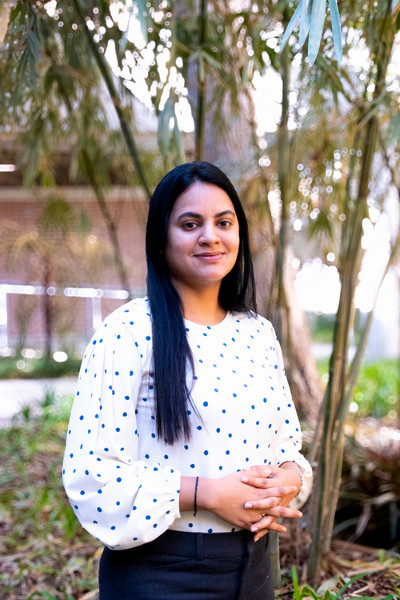
From Foundation to Focus
Kattari's path to UNF was shaped by a strong undergraduate foundation in computer science and a clear desire to push further. Rather than move directly into industry, she chose to pursue graduate study to deepen her technical expertise and gain meaningful exposure to real-world applications.
"I wanted to deepen my understanding of computer science while gaining hands-on experience with real-world data," she said. "The program's emphasis on practical learning and faculty-guided projects gave me the opportunity to apply coding skills to meaningful problems."
Her primary area of focus within the program has been data science — specifically the full data lifecycle, from collection and preprocessing through exploratory analysis and visualization. Working primarily in Python, she has developed fluency with tools such as Pandas, NumPy, and Matplotlib to clean, analyze, and surface insights that support data-driven decision-making.
A Program Built Around Application
What drew Kattari to the MS CIS program was its structure: a curriculum that connects theory to practice within the same semester, with dedicated class time for project discussions and faculty-guided problem-solving.
"Concepts introduced during lectures are directly connected to projects that we work on throughout the semester," she explained. "This approach made learning more effective for me, as I was able to apply concepts immediately and gain hands-on experience alongside theoretical understanding."
Among the courses she found most rigorous and rewarding was Artificial Intelligence, which pushed her analytical and problem-solving skills through programming-based assignments on algorithms and reasoning techniques.
"Working through those challenges helped me strengthen my logical thinking and better understand how intelligent systems are designed and applied to real-world problems," she said.
Taking Data Science to the City: The State of Jax Project
The centerpiece of Kattari's graduate experience has been her internship with the Florida Data Science for Social Good program at UNF, where she has worked on the State of Jax project — a live, public-facing data initiative developed in collaboration with the City of Jacksonville. The platform makes local civic data accessible and actionable for residents, policymakers, and community stakeholders.
In this role, Kattari contributed to data collection, normalization, and visualization — translating raw civic data into clean, interpretable outputs on a platform used by the public. Throughout the project, she worked closely with faculty mentor Dr. Umapathy, who guided her in understanding project requirements, selecting appropriate data approaches, and developing effective technical solutions.
"This mentorship played a key role in my professional growth and helped me gain confidence in applying data science concepts to real-world problems," said Kattari.
The experience also sharpened her ability to collaborate in a team setting. Working alongside fellow interns, Kattari found that the project preparation she received in the classroom translated directly to the interpersonal and technical demands of a real initiative.
"Each team member contributed different strengths, which encouraged meaningful discussions and improved the overall quality of our work," she said.
Looking Ahead
As she prepares to graduate, Kattari's sights are set on a career as a Data Scientist — a role where she can continue applying her analytical and programming skills to problems that matter. She credits the MS CIS program with giving her both the technical foundation and the practical confidence to pursue that goal.
"The MS CIS program has helped me develop a strong technical foundation while providing consistent exposure to practical problem-solving," she said. "Through applied coursework, project-based learning, and faculty guidance, I have gained confidence to work with real datasets and approach analytical challenges in a structured and effective way."
For students considering the program, her advice is direct: engage actively, seek out real-world opportunities, and lean on the faculty support that defines the program's culture.
"Taking initiative in coursework and seeking real-world experiences can greatly enhance learning and professional growth within the program," she said.