
Externally Funded Research Projects
Applied Environmental Research with Measurable Impact
Externally funded research is central to the Institute of Environmental Research and Education’s mission to advance interdisciplinary environmental research and address real world challenges. Through partnerships with federal, state, and local agencies, as well as nonprofit and community organizations, these projects provide critical resources for faculty-led research, supporting the collection and analysis of data that informs environmental understanding and decision-making.
This research generates actionable insights and practical solutions across key focus areas. The resulting data strengthens environmental management strategies, supports evidence-based policy, and contributes to long-term resilience in natural and built systems. In addition, these projects provide valuable opportunities for student engagement, offering hands-on research experiences that enhance learning and prepare students for future careers.
Funded Projects
-
Aquatic Connectivity
Assessing Infrastructure Vulnerability and Aquatic Connectivity Benefiting Resilience of Florida's First Coast
Erin Largo-Wight Ph.D., Director and Professor, Institute of Environmental Research & Education
Jessica Barnes, Ph.D., Visiting Assistant Professor, Institute of Environmental Research & Education
Sydney Barrett, M.S., Research Associate, Institute of Environmental Research & Education
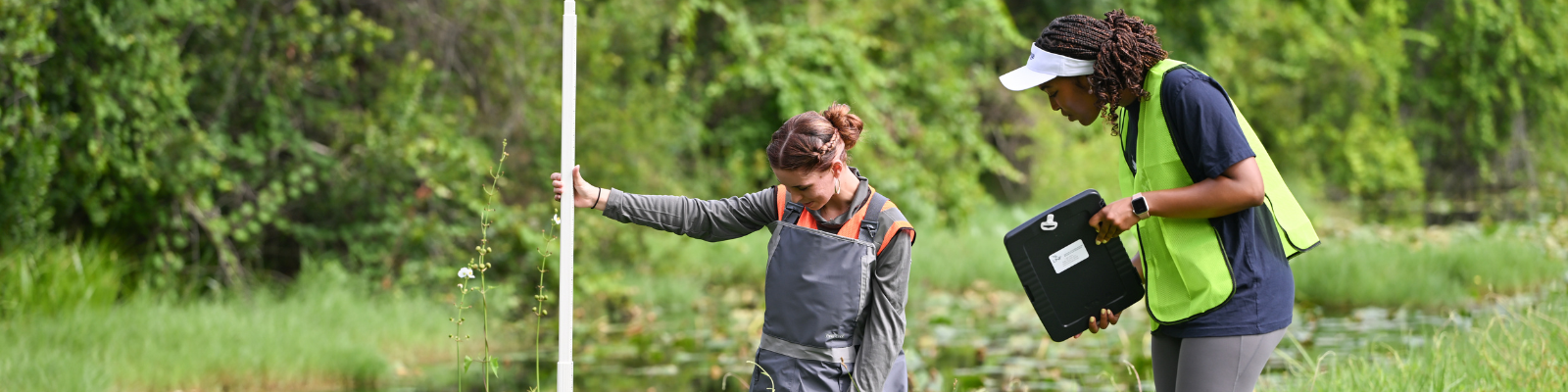
Northeast Florida contains over 4,700 road-stream crossings that lack aquatic barrier survey and assessment data. These barriers, such as undersized culverts, impede natural water flow, undermine public safety, and affect the health and resilience of fish, wildlife, and habitats. Inadequate performance and structure failure of aquatic barriers contribute to flooding of critical infrastructure, communities, and evacuation routes. They also impede the movement of fish and wildlife, fragment habitats, and impair access to resources necessary for genetic diversity and adaptation to changing conditions. The next generation of scientists will conduct aquatic barrier surveys and assessments at road stream crossings in NE FL. Results will be disseminated to inform the identification, prioritization, and planning of future barrier removal projects. Implementation of such projects would replace undersized culverts with floodplain-spanning structures at prioritized sites and reduce maintenance costs from blockages at undersized culverts, mitigate upstream flooding risks, replicate natural passage conditions for fish and aquatic wildlife, and provide more resilient water crossing structures for transportation users and communities. The work has the potential to identify projects benefitting at least 7 threatened species. Ultimately this project will facilitate vital efforts to enhance coastal resiliency, improve aquatic connectivity, and support community resilience in Northeast Florida.
-
Nature's Glow
Nature's Glow: The Efficacy of a Brief Indoor Nature Intervention of Blood Pressure, Pulse Rate, and Self-Reported Stress
Erin Largo-Wight, Ph.D., Director and Professor, Institute of Environmental Research & Education
Heather Barnes Truelove, Ph.D., Professor, Department of Psychological & Brain Sciences
Sydney Barrett, M.S., Research Associate, Institute of Environmental Research & Education
Katie Wilkinson, Graduate Research Assistant, Institute of Environmental Research & Education
Katie Young, Graduate Research Assistant, Institute of Environmental Research & Education
There is a growing recognition that indoor nature exposures are associated with positive health and well-being. Nature contact exposure has been associated with reduced stress, improved attention, improved recovery following surgery, and enhanced well-being among many populations including children, adults, employees, and patients. Most of the previous applied research has taken place in healthcare or workplace settings and focused on indoor features such as window view, natural sunlight, and plants (Elsadek et al., 2021; Frumkin 2001; Frumkin et al., 2017; Largo-Wight, 2011; Largo-Wight et al., 2024; Perrins et al., 2021). The Biophilia Hypothesis and Environmental/Attentional Restoration Theory (ERT/ART) are theoretical frameworks that explain how natural elements reduce stress and promote health in people today through the lens of evolutionary biology and models of stress, coping, and health. In a nutshell, bringing nature indoors - where Americans spend more than 90% of their time - is a strategy to create more biologically familiar spaces, which appears to alter the stress and coping balance in favor of more beneficial coping and health outcomes (Largo-Wight et a., 2024; Kaplan, 1995; Ulrich et al., 1991).
The focus of this study is on comparing forms of indoor nature exposure on psychological and physiological stress and relaxation. Here we will explore a potential, less studied nature contact exposure—nature-infused candles – and a well-established nature contact exposure – potted plants.
-
NOAA Marine Debris Program Reduce Single Use
Reducing single-use plastic on college campuses: Theory of planned behavior based brief interventions
Heather Barnes Truelove, Ph.D., Professor, Department of Psychological & Brain Sciences, University of North Florida
Erin Largo-Wight, Ph.D., Director and Professor, Institute of Environmental Research & Education, University of North Florida
Amy N.S. Siuda, Ph.D., Professor, Department of Marine Science, Eckerd College
Shannon Gowans, Ph.D. Professor, Department Marine Science and Biology, Eckerd College
Hollie Minichiello, Graduate Research Assistant, Department of Psychological & Brain Sciences, University of North Florida
Juliette Hill, Graduate Research Assistant, Department of Public Health, University of North Florida
Single-use plastic poses significant harm to the natural environment, highlighting the need for effective, theory-based strategies to reduce consumption. This study examined the impact of two brief interventions designed to encourage plastic reduction on college campuses and explored whether changes in behavior were influenced by factors within the extended Theory of Planned Behavior, including attitudes, social norms, perceived control, moral considerations, and self-identity. Participants completed measures of their plastic-related beliefs and behaviors, engaged in either a tracking-based or pledge-based intervention, and then completed follow-up assessments.
-
St. Johns River Report
State of the River Report for the Lower St. Johns River Basin
The State of the River Report is a collaborative effort by a team of academic researchers from Jacksonville University, University of North Florida, and Penn State Berks. The report is supported by the Environmental Protection Board of the City of Jacksonville. The purpose of the project is to review data and literature about the river and to present it in a format readable to the general public.
The Eighteenth State of the River Report is a summary and analysis of the health of the Lower St. Johns River Basin (LSJRB). The Report addresses four main areas of river health: water quality; fisheries; aquatic life; and contaminants. This year’s findings indicate the need for concern in many aspects of the health of the River.
-
Jacksonville Heat Map
2022 Jacksonville Heat Mapping Project
During the summer of 2022, citizen scientists measured temperatures across Duval County during a one-day heat-mapping campaign with the goal of collecting data that would reveal the hottest and coolest neighborhoods in our area.
Scientists at the University of North Florida and the Chief Resiliency Officer for the City of Jacksonville used the temperature and humidity data to create temperature maps of the region. These maps will allow Jacksonville to develop policies and projects that address heat-related health issues and lower the risk of heat stress.
-
Researcher Profiles
Externally Funded Research (2020 - Present)
 Raphael W. Crowley, Ph.D.
 Erin Largo-Wight, Ph.D.
UNF Subaward Principal Investigator
National Fish and Wildlife Foundation (NFWF), National Coastal Resilience Fund (2026-2028)
Assessing Infrastructure Vulnerability and Aquatic Connectivity Benefiting Resilience of Florida’s First Coast
Lead Organization: Northeast Florida Regional Council
Total Award: $399,599
UNF Subaward: $123,716 (Largo-Wight, PI)Awardee and Founding Director
Nature and Health Alliance (2025)
Support for Establishment of the Nature and Health Alliance Chapter in Florida (UNF Nature and Health Center)
Award: $20,000 (Largo-Wight, Awardee)Principal Investigator
Newell Company (2025-2026)
Nature’s Glow: The Efficacy of a Brief Indoor Nature Intervention on Blood Pressure, Pulse Rate, and Self-Reported Stress
Award: $78,018 (Largo-Wight, PI)UNF Subaward Principal Investigator and Co-Principal Investigator
National Oceanic and Atmospheric Administration (NOAA), Marine Debris Program (2020-2023)
Toward Sustainable Campuses: Individual Accountability in Single-Use Plastic Reduction
Siuda, A. (PI), Largo-Wight, E. (Co-PI), Truelove, H., Gowans, S., Bollier, E., Debure, K., & Sherry, J.Total Award: $341,805
UNF Subaward: $110,223 (Largo-Wight, PI) Christopher Baynard, Ph.D.
 Heather Truelove, Ph.D.
Co-Principal Investigator
Newell Company (2025-2026)
Nature’s Glow: The Efficacy of a Brief Indoor Nature Intervention on Blood Pressure, Pulse Rate, and Self-Reported Stress
Award: $78,018 (Truelove, Co-PI)Co-Principal Investigator and UNF Subaward
National Oceanic and Atmospheric Administration (NOAA), Marine Debris Program (2020-2023)
Toward Sustainable Campuses: Individual Accountability in Single-Use Plastic Reduction
Siuda, A. (PI), Largo-Wight, E., Truelove, H. (Co-PI), Gowans, S., Bollier, E., Debure, K., & Sherry, J.
Total Award: $341,805
UNF Subaward: $110,223 (Truelove, Co-PI)