

Environmental Science Internship
Environmental Science degrees at the University of North Florida offer a comprehensive, student centered education grounded in experiential learning and civic engagement. A hallmark of the program is a guaranteed internship, providing students with meaningful, real world experience before graduation.
EVR 4940: Environmental Internship
As a core course, the Environmental Internship, is a required capstone course completed during a student’s final semester. Guided by faculty from the Institute of Environmental Research and Education, students apply classroom knowledge in professional settings through hands-on, experiential learning. Each student is matched with a community or business partner, fostering civic engagement while building practical skills that prepare graduates for career success and lifelong adaptability.


Internship Guarantee
Every Environmental Science major is guaranteed an internship opportunity through EVR 4940. Once placed, students are responsible for meeting all requirements of their internship site.
Finding an Internship
At the beginning of the semester, students receive a list of approved community partners that have expressed interest in hosting Environmental Science interns. Students are responsible for contacting sites during the designated interview period. Community partners select the students they wish to host, and students who receive multiple offers may choose their preferred opportunity. Students who do not secure a position during the interview period will be placed in an internship experience.
Approval Requirements
All internships must be approved through the UNF internship approval process before internship hours can begin.
Course Requirements
EVR 4940 requires 150 internship hours, attendance at course meetings, completion of professional development activities, and a poster presentation at the end-of-semester Symposium.
Internship Structure
- 150 hours completed over 10–11 weeks (about 15 hours per week).
- Offered every Fall (September–November) and every Spring (February–April).
- Internships are project based and may be onsite, hybrid, or mostly remote.
- Internships may be paid or unpaid, depending on the internship site.
- IERE has a list of potential internship sites from environmental agencies, non-profits, research partners, and employers that you will meet (Internship and Networking Fair) and be in contact with (Selection Period), but you are also able to introduce a new potential site for your IERE professor to consider.
- All eligible students are guaranteed an internship.
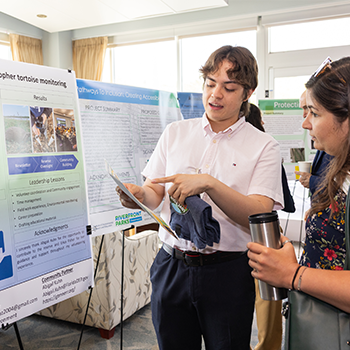
- At the end of the semester, all students complete a professional poster and present at the IERE Internship and Student Symposium.
Eligibility & Required Courses
- Environmental Science B.S. students from both concentrations are required to take the internship course. (Because of capacity issues, students that are not majoring in Environmental Science will not be permitted to take this course. However, IERE has many other opportunities, such as the Environmental Leadership Program, open to all students.)
- Students should take the internship course in their final year.
- Students must complete the following courses beforehand:
- EVR 3008 Environmental Foundations (3) Provides foundational knowledge in sustainability, communication, geospatial data, research skills, environmental policy, management, and field experiences. Introduces diverse environmental career pathways.
- EVR 3083 Environmental Professional Preparation (3) Focuses on career exploration, networking, professional communication, résumé and LinkedIn development, and field or community exposure.
- Students must begin the internship with: An updated résumé
- A professional LinkedIn profile
- Strong interview preparation with articulated future goals
What to Expect in EVR 4940: Environmental Internship
-
Hybrid Course Meetings
The semester begins with in-person and online meetings to prepare students for the internship process. -
IERE Internship Fair & Networking
Students meet internship hosts, community partners, agencies, and employers, and learn about available internship projects. -
Selection Period (1–2 weeks)
After the fair, students contact sites, express interest, and interview. Sites expect communication from students during this window of time and students should expect timely responses. (If a student struggles to secure a site, IERE will place eligible students into an internship — internship placement is guaranteed.) -
Internship Placement & Approval
By the end of the Selection Period, students then complete the Internship Agreement Form, routed to IERE faculty instructor, internship site supervisor, and IERE Dean/Chair. Once approved, students may begin logging hours. -
During Internship
There are several weekly requirements and course assignments and expectations throughout internship, such as:
- Weekly reflections submitted in Canvas
- Weekly check-ins and feedback with internship supervisors
- Required check-ins with IERE faculty
- A mid-semester reflection completed by both student and site
- Participation in IERE workshops to prepare their poster for the Symposium
- A final evaluation from both student and site
- Submission of all remaining course assignments
-
IERE Internship and Student Symposium
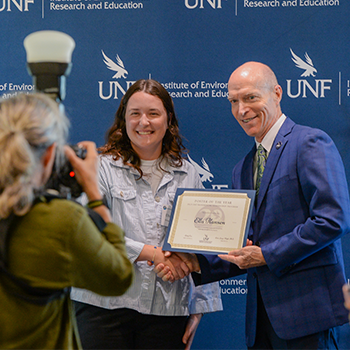
At the end of the semester, all students present their internship work through a professional poster at the IERE Internship and Student Symposium. This event provides students the opportunity to:
- Showcase their project to faculty, staff, students, and community partners
- Strengthen communication and presentation skills
- Build professional confidence and networks
- Contribute to the visibility of environmental work at UNF and in the region
-
Question & Answer
Can I propose my own internship site?
Possibly. Students must contact IERE (environment@unf.edu) at least 60 days before the semester begins. Proposed sites must be approved and are not guaranteed.Can I complete my internship outside Jacksonville?
Possibly, but students are still required to attend in-person course meetings and present at the Symposium.Can my current job count as my internship?
Possibly, if the position aligns with program requirements and is approved through the internship process.Can I use a research assistantship as my internship?
Possibly, if the experience aligns with program requirements and is approved through the internship process.Can I complete my internship online?
Some community partners offer online or hybrid internship opportunities. These positions are limited and competitive, and students must still attend required in-person course meetings and present at the Symposium.Can a previous internship or Environmental Leadership Program experience count toward EVR 4940?
No. Previously completed experiences cannot be used to fulfill the internship requirement.Will my internship be paid?
Some internship opportunities are paid, while others are unpaid.Questions?
Contact IERE at environment@unf.edu.

Faculty and Advising
- Erin Largo-Wight, Ph.D. - Professor, Chair, & Functioning Dean
- Heather Truelove, Ph.D. - Professor & Program Director, & Assistant Chair
- Erica Kirk - Student Advisor, (904) 620-2777
- IERE Teaching Faculty