
Renowned literacy scholar shares strategies for publishing in high-impact journals with UNF graduate students and faculty
November 12, 2026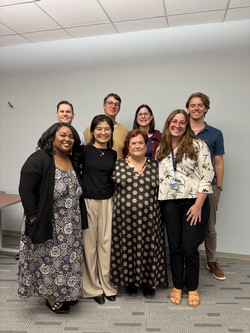
The Silverfield College of Education and Human Services welcomed Dr. Patricia A. Alexander for a workshop on publishing academic work in high-impact journals on Friday, Oct. 23.
Alexander is a Distinguished University Professor and the Jean Mullan Professor of Literacy at the University of Maryland, College Park. The workshop was designed for doctoral students and faculty and open to all UNF graduate students. Alexander regularly presents a similar session at the annual meeting of the American Educational Research Association (AERA), so UNF attendees received the same guidance she shares with scholars at one of the field’s largest gatherings.
Alexander drew on 40 years in the academy as a professor, advisor, researcher, journal board member and journal editor. She shared both her setbacks and her successes, and the audience responded to her candor. Her central message was that publishing is a pleasure and not a punishment. Scholars have the privilege of generating new ideas and sharing them with others, and she encouraged attendees to begin with a topic they care enough about to write for themselves.
Building a program of research
Alexander urged attendees to start by reading related articles often and building deep knowledge around a topic that holds their interest. She noted that many manuscripts fall short because of a weak theoretical framework, often because authors know only the most recent literature and not the history or the fields that shaped it. Her advice was to begin a line of research with a foundational literature review, which tends to earn the highest citations, and to bring a new twist to a field from an outside one.
She encouraged writing every day, even if only a 30-minute free write, and never going to bed without writing something. Waiting for a designated block of time, she said, makes the work harder. She also asked attendees to decide what they want to be known for and to keep that core in focus. Offshoots can add value, she said, but they should not pull a scholar away from the core. When asked how many articles are enough, she answered that a scholar should keep publishing until reaching saturation. She also showed attendees how to turn presentations and class assignments into manuscripts.
Writing for the right journal
Alexander explained that every journal has its own voice, tone and audience. She advised writers to choose a target journal before drafting, find a model article to follow and review the editorial board to see which themes its members are publishing. She also shared how to persist through rejections and revision requests from reviewers and editors. For endings, she encouraged writers to be a little dramatic and to include both a delimitation, a choice made in setting a study’s parameters, and a limitation, something unplanned that arose along the way.
The workshop was highly interactive. Students and faculty at every stage of their careers traded experiences and committed to trying specific strategies. Some attendees spontaneously agreed to form writing groups or begin new collaborations.
For Alyssa Elaskari, an Ed.D. student, the workshop changed how she saw a paper she wrote for a class this summer. “Dr. Alexander reminded us that we get to think of things and share them with others, and that is a privilege,” Elaskari said. “I came away understanding that a class assignment can become a manuscript, and I felt encouraged enough to reach out to a faculty member about publishing mine.”
For doctoral students, publishing is a central part of becoming a scholar, and the process can feel opaque without guidance. Hearing directly from an editor and board member who has seen both sides of peer review gave UNF students practical tools for turning coursework and research into published work that contributes to their fields.
The visit was also a reunion. Silverfield Associate Dean Dan Dinsmore, who hosted the workshop, is one of several former doctoral students Alexander mentored who attended. Drs. Chris Weber, Meghan Parkinson, Yuting Sun and Eric Schoute were also her mentees.
“Having Dr. Alexander on our campus was a gift to our students and faculty,” Dinsmore said. “She was honest about her own rejections and revisions, and that honesty made the publishing process feel achievable for everyone in the room.”