

English (M.A.)
Deepen Your Expertise. Advance Your Career. Earn Your M.A. in English at UNF.
The Master of Arts in English at the University of North Florida is built for students who want to go further. In small graduate seminars with active faculty scholars, you will sharpen your critical reading and writing, engage with British, American and world literary traditions and develop the analytical and communication skills that open doors in higher education, professional writing, publishing and beyond. The program is 33 credit hours across 11 courses, with two concentrations and a general track designed to match your goals.
General English Track (M.A.)
Explore poetry, drama, fiction, film and contemporary literary theory across British, American and world traditions. Small seminars with graduate faculty and a thesis option make this the path for serious literary scholars.
Concentration in Creative Writing
Develop your craft in dynamic workshops alongside faculty actively engaged in the writing world. Hone form, style and voice while deepening your understanding of literary genres, traditions and the contemporary literary environment.
Concentration in Composition and Rhetoric
Prepare for college-level teaching, technical writing, editing or publishing. Three courses in theory, research and pedagogy build the credentials you need for writing instruction at community colleges, universities and in industry.
Already Enrolled in the English B.A.? Earn Your Master's in One Additional Year.
UNF's 4+1 Accelerated Program lets you take up to three graduate courses while completing your bachelor's degree. Up to nine credit hours count toward both degrees, and you enter the M.A. program without taking the GRE. A 3.5 GPA in your English courses and 21 completed hours of English major requirements are all you need to apply. Start the conversation with your advisor at the beginning of your junior year.
Job Outlook
What Can You Do With a Master's in English?
M.A. graduates from UNF go on to careers in higher education, professional and technical writing, publishing, communications and doctoral study. The degree is built for students who want to teach, write, lead or advance into competitive graduate programs.
For current salary and employment outlook data, visit the U.S. Bureau of Labor Statistics Occupational Outlook Handbook.

The Value of an M.A. in English
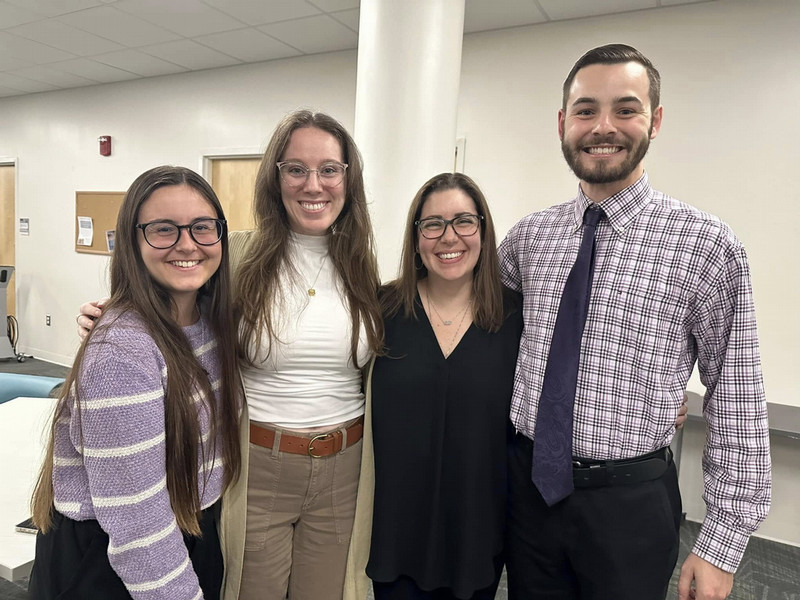
A master's degree in English from UNF is not a single credential with a single purpose. It is a flexible investment that serves different students in different ways depending on where they are and where they want to go.
- Develop the analytical, interpretive and writing skills that distinguish strong scholars and communicators in any field
- Prepare to teach composition, rhetoric and literature at the community college level
- Deepen pedagogical strategies for secondary-level English and writing instruction
- Build expertise as a technical writer, editor or publishing professional
- Strengthen your application for doctoral programs in literature and cultural studies
- Engage more deeply with literary tradition as a practicing creative writer
Financial Support
The UNF Graduate School offers information on graduate financial aid and graduate scholarships. The Department of English also offers graduate assistantships on a limited basis. Contact the Graduate Coordinator for more information about assistantship availability and how to apply.
Writing Support
The UNF Writing Center offers writing support for graduate students across disciplines, from education and English to business and nursing, both in person and virtually via Microsoft Teams. Learn More.
Application Deadlines
| Fall Aug. 1 |
Spring Dec 1 |
Summer April 15 |
READY TO UNLEASH YOUR POTENTIAL WITH UNF?
Degree Tracks and Concentrations
-
English, M.A. — General Track
The Master of Arts in English at UNF gives you a rigorous foundation in literary study across British, American and world traditions. In small graduate seminars with active faculty scholars, you will sharpen your critical reading and writing, engage with poetry, drama, fiction, film and contemporary literary theory and develop the analytical depth that prepares you for doctoral study, teaching and professional advancement.
The program is 33 credit hours across 11 courses. Students who want classroom teaching experience can enroll in graduate teaching practica after completing 18 hours of graduate study.
Students interested in college-level classroom experience or independent research may work directly with faculty members to arrange a practicum or directed independent study after completing six courses. In the program's 11 courses, students may enroll in a maximum of two practica, two independent studies or one of each.
View the M.A. in English program of study -
English, M.A. — Concentration in Creative Writing
Graduate students concentrating in Creative Writing develop their craft while deepening their understanding of literary genres and traditions. Dynamic workshops, independent studies and special topic offerings explore techniques and trends in the contemporary literary writing environment.
Alongside courses that examine influential authors and literary movements, graduate work in Creative Writing provides dedicated time to experiment with forms, hone editorial skills and work closely with faculty actively engaged in the writing world. The goal is for each student to master form, style and voice.
View the Concentration in Creative Writing program of study -
English, M.A. — Concentration in Composition and Rhetoric
A number of graduate students in the M.A. program go on to teach writing at community colleges, and some teach in UNF's Writing Program. The Concentration in Composition and Rhetoric is designed for students pursuing those pathways, as well as careers in technical writing, editing and publishing.
The concentration is nine credit hours across three courses. Students take courses in theory, research, pedagogical issues and technical writing. A teaching practicum is available following the completion of background courses in composition and rhetoric.
This concentration is also recommended for secondary-level English teachers who provide writing instruction and want to deepen their professional qualifications.
View the Concentration in Composition and Rhetoric program of study -
English, B.A. to M.A. — Accelerated 4+1 Program
The Accelerated B.A. to M.A. in English is designed for high-achieving undergraduates who want to earn both degrees in approximately five years. In your senior year, you take up to three graduate courses that count toward both your bachelor's and master's degrees, giving you a significant head start before you graduate.
The financial advantage is real. Because those graduate credits are taken while you still hold undergraduate status, you may be able to apply undergraduate financial aid and scholarships toward them. You also enter the M.A. program without taking the GRE.
To be eligible you will need to:
- Be majoring in English at UNF with a 3.5 GPA in your English courses
- Complete 21 hours of English major requirements, including ENG 4013 Approaches to Literary Interpretation, before applying
- Meet with the COAS English Undergraduate Advisor and the Graduate Program Director at the start of your junior year
- Submit two letters of recommendation from UNF Department of English faculty
The application happens during your junior year, so the earlier you start planning the better. Graduate classes replace nine hours of undergraduate study, so undergraduate courses must be planned carefully to ensure the right classes are available to replace with graduate coursework.
Learn more about the 4+1 application process
Admission Information
-
Admission Requirements and Sequence — M.A. in English
Applicants must satisfy both the State University System general requirements and the specific requirements of the Department of English M.A. program.
Requirements
- A minimum GPA of 3.0 or higher for the last two years (60 semester hours) of undergraduate coursework.
- A B.A. in English or a related field.
- A course in literary criticism, such as ENG 4013 or ENG 4014, with a grade of B or higher. Applicants who lack such a course but who otherwise meet the admissions requirements may take ENG 4013 or ENG 4014 as part of the admissions process. While not required, LIT 3213 (The Art of Critical Reading) is recommended.
- A writing sample submitted to the Graduate Coordinator. The sample should be four to seven pages of literary criticism, composition research or rhetorical analysis, not creative writing or personal essay. A paper written for an undergraduate literature class is appropriate.
Meeting the minimum requirements does not guarantee a place in the M.A. program. Candidates need to demonstrate that their previous studies have given them the tools to complete graduate-level work successfully. For more complete coverage of procedures, see the Graduate Handbook.
Admission Sequence
- Complete the university's application forms.
- Once the Admissions Office receives your transcripts and writing sample, an Admissions Officer will forward a Graduate Referral to the Graduate Coordinator, who will make the final decision concerning acceptance.
- An Admissions Officer will then send a formal letter with the Graduate Coordinator's decision.
- Meet with the Graduate Coordinator as soon as possible to review your program of study.
Academic Distinctions and Graduate Community
-
English Graduate Organization (EGO)
The English Graduate Organization is a social and pre-professional organization for graduate students in UNF's English department. EGO gives graduate students a way to contribute to the life of the department, advise one another and navigate graduate study together.
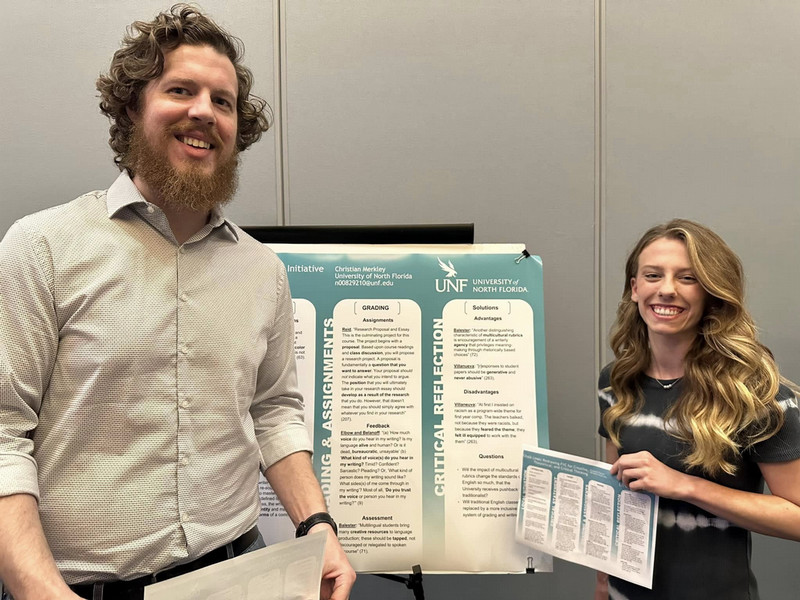
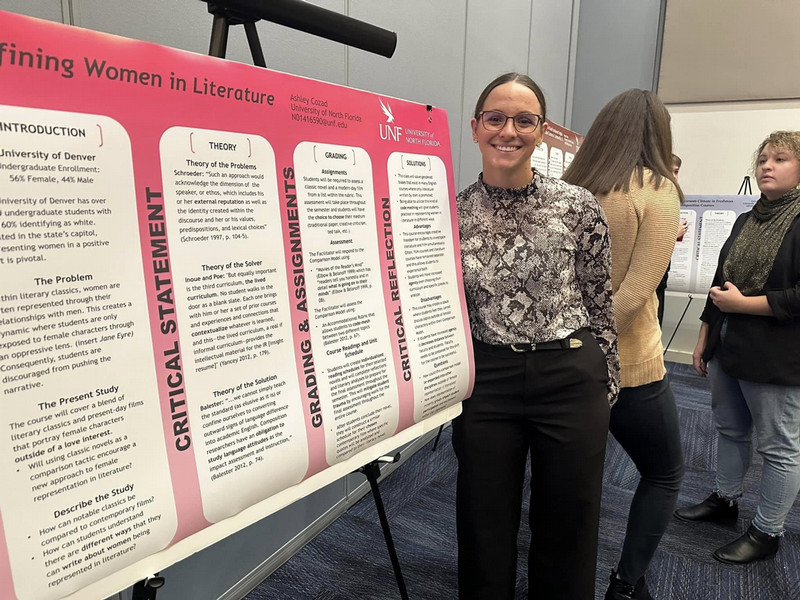
EGO co-hosts the Annual English Graduate Student Conference, holds readings of critical and creative writing and organizes sessions on topics of interest to graduate students.
Biannual Graduate English Conferences
Since 2000, the English Graduate Program and EGO have sponsored a graduate English conference every year in which current graduate students and alumni deliver scholarly papers. The event gives students and alumni experience in one of the central activities of university-level critical writing. Starting in 2009, EGO and the program expanded to two conferences per year, one in fall and one in spring. A free lunch is served.
Benefits of Presenting a Paper
Students are encouraged to ask their instructors whether presenting a conference paper can count for course credit in their 6000-level courses. All students in the program should try to deliver a paper at least once. It is one of the most direct ways to build a scholarly record before entering the academic job market or applying to doctoral programs.
Contact Academic Advising
Graduate students in the M.A. in English program are advised by the Graduate Coordinator. All newly admitted students should meet with the Graduate Coordinator to identify their program aims, discuss their options and develop their initial program of study. Students interested in applying are encouraged to contact the Graduate Coordinator before submitting an application to discuss the program and any application concerns.
DO NOT DELETE THIS TIER (TEXT WILL NOT SHOW UP ON SITE BUT THERE IS CODE HERE FOR FUNCTIONALITY PURPOSES)