
History (M.A.)
Advance Your Future with a Master’s in History at UNF
Build advanced historical knowledge and the research skills to match. The UNF M.A. in History offers rigorous coursework across world regions and time periods, with thesis and non-thesis concentrations that support career advancement and doctoral preparation. Students develop a clear research agenda, grow as writers and scholars and gain practical experience through teaching, internships and public facing work. This is graduate study with direction, grounded in evidence, perspective and impact.

Career Pathways
- Higher Education and Teaching: Preparation for teaching roles, academic support positions and doctoral study pathways, supported by strong research training and presentation experience.
- Museums, Archives and Public History Leadership: Career growth in museums, historical societies, cultural institutions and preservation organizations through research, interpretation, collections work and public engagement.
- Government, Policy and Public Service Research: Opportunities in policy research, program evaluation, public administration support and historical research roles in government and nonprofit settings.
- Research, Writing and Communications Careers: Competitive preparation for roles that require deep research, clear writing and synthesis, including publishing, communications, grant writing, content strategy and analyst work.
History M.A. Graduates: Where Are They Now
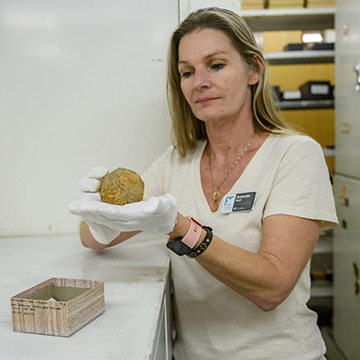
Dr. Amanda Hall, M.A. History (2013)
Dr. Amanda Hall completed her M.A. in History at UNF, where she gained hands-on experience in archaeological fieldwork and archival research. She is now the collections manager for Florida and Caribbean archaeology at the Florida Museum of Natural History. Read more!

Victoria Jones, M.A. History (2018)
Victoria Jones strengthened her skills in public history and digital preservation while completing her M.A. in History at UNF. She now serves as an archivist at Florida Gulf Coast University and recently returned to UNF to present her work digitizing the Lee County Black History Society Collection.

Ariel LaGue, B.A. 2012; M.A. 2014
Ariel LaGue earned her B.A. and M.A. in History at UNF before completing her Ph.D. in American History at the University of Kansas. She is now pursuing a postdoctoral fellowship at the Center for the American West at the University of Colorado Boulder.
Application Deadlines
|
Fall Start: June 1 |
Spring Start: Oct. 1 |
READY TO UNLEASH YOUR POTENTIAL WITH UNF?
Thesis Concentration
-
Thesis Option
The thesis option is designed for students who want to pursue advanced, original historical research under close faculty mentorship. This path is ideal for students considering doctoral study, teaching or research focused careers.
- Students may take no more than one HIS 6905 Directed Independent Study or one HIS 6946 Internship in History
- Directed Independent Studies, internships and courses taken outside the department do not substitute for required readings courses or research seminars
Students who choose the thesis option complete the following coursework:
- Three 6000-level readings courses in AFH, AMH, ASH, EUH, HIS and or LAH (9 credit hours)
- Three 6000-level research seminars (9 credit hours)
- Four elective courses at the 5000 or 6000 level, including at least two in non-Western history (AFH, ASH or LAH)
- Six to fifteen credit hours of HIS 6971 Thesis Research
-
The Thesis
Students interested in writing a thesis are encouraged to begin discussions with history faculty during their first year of study to explore research topics and identify a potential thesis advisor. Faculty may require specific language preparation or methodological training prior to approving a thesis proposal.
Admission to the thesis track is finalized through approval of a formal prospectus. The prospectus must clearly outline:
- The research question or working hypothesis
- The approach and source materials to be used
- The scholarly significance of the project
The prospectus must be approved by the thesis advisor and two additional committee members. Approval is documented through committee signatures and submitted to the graduate coordinator.
-
Thesis Committee
Each thesis committee includes at least three graduate faculty members, with a minimum of two historians.
- The thesis advisor, who must be a historian, is selected by the student when the thesis option is chosen
- Additional committee members are selected by the student in consultation with the thesis advisor
-
Timeline
Students in the thesis option have up to two years after completing coursework to write and defend the thesis.
- Continuous enrollment in HIS 6971 Thesis Research is required, except during summer terms
- Students must complete at least six and no more than fifteen credit hours of thesis research
Students who do not complete the thesis within the two-year timeframe may be required to transition to the non-thesis option and complete additional coursework and a final oral examination during a third year.
-
Thesis Preparation
Master’s theses prepared for the Department of History must follow the Chicago Manual of Style and use footnotes rather than endnotes. Theses must also conform to all university manuscript guidelines, which are available through the UNF Library.
-
Defense and Final Approval
Once the thesis is complete, students submit the manuscript to the committee and work with the thesis advisor to schedule a public oral defense.
- Defenses should be scheduled at least four weeks before commencement to ensure timely graduation
- Following a successful defense, the thesis is reviewed by the department chair and the Graduate Dean
- Revisions may be required prior to final approval
After the thesis is fully approved, students are responsible for completing the university’s electronic thesis submission requirements.
Non-Thesis Concentration
-
Non-Thesis Option
The non-thesis option is designed for students who want to complete advanced graduate coursework and demonstrate research proficiency without writing a master’s thesis. This path is well suited for students seeking career advancement, professional application of historical skills or preparation for further study without a thesis requirement.
- Students may take a combined maximum of nine credit hours in HIS 6905 Directed Independent Study and HIS 6946 Internship in History
- Of those nine credit hours, students may take no more than six credits in either Directed Independent Study or Internship coursework
- Directed Independent Studies, internships and courses taken outside the department do not substitute for required readings courses or research seminars
Students who choose the non-thesis option complete the following coursework:
- Three 6000-level readings courses in AFH, AMH, ASH, EUH, HIS and or LAH (9 credit hours)
- Three 6000-level research seminars (9 credit hours)
- Six elective courses at the 5000 or 6000 level (18 credit hours), including:
- At least two courses in non-Western history (AFH, ASH or LAH)
- At least two courses at the 6000 level
-
Final Research Paper and Presentation
Students in the non-thesis option complete a capstone research experience that demonstrates advanced historical analysis and scholarly writing.
The capstone requirement includes submission of a research paper of at least twenty pages, written for a UNF graduate course within the student’s program of study. The paper may be revised prior to submission.
A committee of three faculty members, selected in consultation with the graduate program director and including the faculty member who taught the research seminar, will review the paper and determine its readiness for defense.
- Students present their research in a formal oral presentation
- The presentation is followed by questions and discussion with the faculty panel
- Students are expected to explain their findings and place the work within an appropriate historiographical context
The results of the presentation and defense are evaluated as Satisfactory or Unsatisfactory and communicated to the student and the graduate program director.
Internships for History Students
-
Why Consider an Internship?
An internship helps history students develop practical skills and explore career paths while still in college. Many students use internships as a stepping stone to full time employment or graduate study.
- Gain professional experience employers value
- Apply research, writing and analytical skills outside the classroom
- Build connections with museums, cultural organizations and public agencies
- Explore careers in historic preservation, public history and community engagement
Internship opportunities may include work in historic preservation, museum collections, exhibit design, oral history and cultural resources interpretation.
-
How to Arrange an Internship
Students may explore internship opportunities through the department, local organizations or on their own. Once an opportunity is identified, students must meet with the department chair for approval before applying.
- Identify an internship opportunity that matches your interests
- Schedule a meeting with Dr. David Sheffler to discuss the opportunity
- Apply to the sponsoring organization after departmental approval
- Obtain permission to register once the position is offered
Graduate students register for HIS 6946 and must complete at least 200 hours. Internships earn three elective credits and may be completed up to two times for a maximum of six credits.
Internships do not substitute for required 4000 or 6000 level seminars.
-
Recent Internship Sites
In recent years, UNF history students have completed internships with a variety of respected organizations across Northeast Florida, including:
- Durkeeville Historical Society
- Museum of Science and History (MOSH)
- The Cummer Museum of Art & Gardens
- Jacksonville Historical Society
- Timucuan Ecological and Historic Preserve and Fort Caroline National Memorial
The Department of History also sponsors internships with additional museums, cultural institutions and public agencies throughout the region.
Learn More
For questions about internships or to begin the approval process, please contact:
Dr. David Sheffler
Chair, Department of History
(904) 620-1856
david.sheffler@unf.edu
Graduate Teaching Assistantships and Scholarships
-
Graduate Teaching Assistantships
The History Department is able to offer a limited number of Graduate Teaching Assistantships. Students selected to serve as GTAs receive a substantial stipend plus a partial tuition waiver for up to two years.
-
Scholarships
Besides Teaching Assistantships, several scholarships and grants are available to incoming or existing graduate students on a competitive basis.
For more information, please contact our Graduate Program Director, Dr. Chau Kelly at chau.kelly@unf.edu. You may also contact Dr. David Sheffler, Chair, at david.sheffler@unf.edu.
Contact the Program Director
Dr. Chau Johnsen Kelly
For questions regarding the application process or to begin an online application please contact: The Graduate School