
UNF collects rare solar eclipse data during NASA-supported mission in Spain
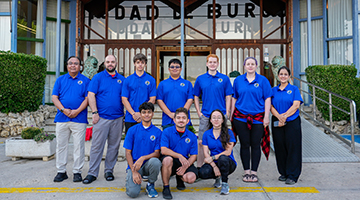
A team of University of North Florida students and faculty traveled to Burgos, Spain, last month to collect scientific data during the August 12 total solar eclipse as part of a NASA-supported research project that provided students with hands-on experience in engineering and high-altitude scientific research.
The NASA Nationwide Eclipse Ballooning Project selected and funded only three universities, UNF, Montana State University and the University of Bridgeport, to participate in the international mission. The selection was based on several years of successful collaboration between UNF and the NASA project.
The UNF team was led by Dr. Nirmal Patel, a faculty member in physics, whose sensor payload has been selected annually by the NASA-High Altitude Student Payload (HASP) research project since 2008, and Dr. Hemani Kaushal, an assistant professor of electrical engineering. The seven-member student team included electrical engineering majors Jorge Meza, Curren O’Brian, Henry Chea and Stella Brantley, as well as mechanical engineering students Aren Bronton, Yechiel Bulman and Amy Pagurko.
Meza said the experience broadened his perspective, expanded his knowledge and gave him the opportunity to learn beyond the classroom.
Bronton shared that the trip to Spain was a game-changing opportunity for him to gain hands-on experience in engineering and high-altitude scientific research.
Bulman was impressed by the opportunity to collaborate with a multidisciplinary team and international partners to execute a real-world science and engineering mission.
Brantley and Pagurko said that, after months of research and preparation, watching the balloons rise into the sky while the moon was covering the sun was a truly awe-inspiring moment.
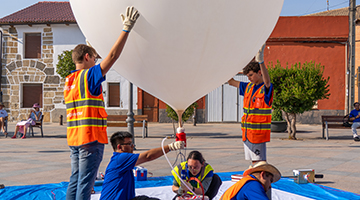
The UNF team collaborated with Dr. José Francisco Romero García and students from Colegio Retamar in Madrid, Spain. The hosts provided essential support by managing insurance and permits, procuring and delivering equipment and offering excellent hospitality, including a city tour and a visit to the Cathedral of Saint Mary of Burgos, Spain. Despite being on summer vacation, 18 Spanish students participated with the UNF team in launching and recovering three high-altitude balloons before, during and after the eclipse.
 Oscar Serna Azpeleta, mayor of Melgar de Yuso, Burgos, provided logistical and transportation support and accompanied the UNF team as a local guide on the day of the eclipse, even assisting in recovering the balloon payload at night.
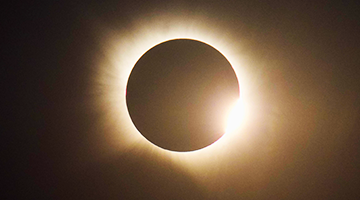
The eclipse was unique because it occurred in the evening and concluded with a striking sunset over the Mediterranean. The UNF team provided solar eclipse glasses to more than 250 residents of Melgar who gathered to watch the balloon launch and eclipse.
The UNF team designed and constructed several research payloads to measure atmospheric conditions such as temperature, humidity, pressure, dew point and ozone concentration. These instruments also collected data on energetic particle radiation levels, radio communications and images captured during totality. All three balloons were equipped with scientific payloads, including a flight data recorder, ozone sensor, radiation detectors, long-range communication (LoRa) system, Iridium modem, 360-degree camera, GPS trackers and an altitude meter.
Upon returning from Spain, the team began data analysis and found compelling results that aligned with the mission's objectives. The primary findings included a decrease in stratospheric ozone concentration as well as a reduction in high-energy radiation counts at higher altitudes during the eclipse. The LoRa payload demonstrated effective long-range communication between the ground station and balloon payload.
 Also, NASA-HASP recently launched two additional UNF payloads, the Osprey Ozone Sensor and LoRa, on Sept. 2, 2026. More than 10 UNF students participated in the program. Both payloads yielded significant results.
The next step for the UNF team is to await another solar eclipse opportunity to validate their research results using enhanced payloads.
Additional support for the project was provided by the Florida Space Grant Consortium, USA; Dr. Angela De Jardins, director of NEBP and Montana State Space Grant Consortium; and Dr. Jaydeep Mukherjee, director of the Florida Space Grant Consortium.