
Transforming Retention at UNF: A Holistic, Data-Driven Journey to Student Success
At the University of North Florida (UNF), one simple concept prompted a holistic redesign of its student success ecosystem and has yielded dramatic results. It all started with the question: What would happen if we put the student experience at the center of everything we do?
UNF’s shift in culture and a unified, data-driven approach has transformed student success outcomes, including a first-year retention increase from 79% to 87% in five years. This case study breaks down how UNF redefined operations from the ground up, providing a clear, replicable blueprint for other universities looking to elevate the student experience and success outcomes at their own institutions.

FROM FRAGMENTED TO FOCUSED
UNF is part of the State University System of Florida, named by U.S. News & World Report as the top state for higher education in the country nine years in a row. The system functions on a performance-based funding model across its 12 universities, including multiple student success metrics. Like many younger regional public institutions, UNF historically struggled on first-year retention and graduation rates, metrics that Florida’s performance-based funding system emphasizes. Informed by our National Survey of Student Engagement data, we began to understand reasons contributing to past performance challenges. We learned that while UNF students loved their university, many were frustrated by inconsistent processes, dense communication and the exhausting effort often required to resolve problems in a siloed system. To improve, we assessed the entire student journey.
Our evaluation revealed that student-facing units operated independently, with inconsistent standards and little coordination on the student experience. Academic advising, for instance, followed a term-by-term advising model focused on the next term’s course selection rather than comprehensive, 4-year degree planning. Records, financial aid and registration processes were cumbersome and often confusing for students and staff alike. New student orientation was transactional, with attendees telling us they spent too much time passively listening during orientation and wanted something more engaging.
Early alert systems were underutilized, leaving faculty frustrated by a lack of information about the alerts they submitted and any follow up that had occurred. The absence of a unified data infrastructure prevented real-time intervention. Systems and processes were not always transparent and did not always take into account the impact on the student experience.
A shift in mindset would change everything.
With bold leadership and a newly created Student Success division, UNF committed to a radical shift: From fragmented processes to a seamless, student-centered experience.
This cultural shift was reinforced by the expectation that all divisions, regardless of functional area, must align their goals and performance indicators to student success. For the first time, academic deans, student success leaders and enrollment managers worked from a common playbook and shared accountability measures. This coordination was new, unfamiliar territory. Yet, it was important that student success no longer be seen as the sole responsibility of advisors. Instead, it became everyone’s business. The president and provost made “student success” a cornerstone of every speech, every meeting and the institution’s strategic plan.
LAYING THE GROUNDWORK: STRATEGY AND STRUCTURE
UNF’s change began with intentional questions and cross-campus collaboration. A new Student Success Advisory Council was charged by the president and provost with a mandate to act — not just advise. Through focus groups with students and frontline staff, the committee gathered valuable data on persistent pain points. From this, we identified quick wins and systemic reforms for our path ahead.
Three strategic pillars guided the transformation:
- Align People and Structures: Merge academic advising, tutoring, career services, admissions, financial aid and registration under unified leadership.
- Modernize Processes and Policies: Audit and revise outdated policies and eliminate bureaucratic hurdles.
- Empower with Data and Technology: Build platforms and dashboards to support proactive, intentional and personalized outreach.
These pillars, reinforced through new accountability structures, cross-functional teams and new professional development workshops, ensured that everyone was aligned to a shared mission and rowing in the same direction.
Another foundational element was the reorganization of university functions. Student success units were realigned under a single leadership structure that combined academic and enrollment services. This restructuring improved cross-training, transparency and accountability, and gave frontline teams a clearer sense of shared purpose. As a result, students began receiving more consistent and timely responses across all touchpoints, from admission to advisement to registration.
To create and implement a unified vision of student success, UNF established multiple bodies, including the “Student Success Steering Committee” and “Student Roundtable.” These bodies were comprised of student-facing staff and leaders who began meeting regularly to review key metrics and review operational improvements. Complementing this, the "Next Level Student Success" series began offering monthly professional development to connect day-to-day work supporting students to broader strategic goals. These Next Level sessions were also used to introduce and test new technologies and policies before broader rollout, as well as recognize staff for exceptional contributions to the student experience.
EMPOWERING FRONTLINE STAFF AND FACULTY
Central to UNF's strategy was the professionalization of the student success workforce. A student success advocacy team was established to focus on support and interventions for high-risk students. A centralized processing team was created to reduce administrative burdens on advising staff, freeing them to focus on transformational student engagement in their sessions with students. Advisors were no longer expected to be both administrative managers and counselors. Instead, their value was recognized in the quality of their guidance and the engaging relationships they built with students.
 Operational standards were established for walk-ins, appointment availability and staff assignments. Weekly Student Roundtable meetings ensured staff had real-time insights into key metrics, including registration, tutoring utilization and academic alerts. Advisors were now accountable for engaging in multi-term degree planning, supported by DegreeWorks and guided by clear expectations for timely graduation (four years for FTICs, three for Associate in Arts degree transfer students).
Faculty engagement was also prioritized, with an emphasis on building university support for their work with students. Based on faculty feedback, the academic alert system was overhauled to be more transparent and responsive, aligning to best practices from other U.S. institutions (EAB, 2023). Academic alert submissions resulted in immediate outreach by student success advocacy staff, with referrals to academic support resources. Faculty were notified about actions taken, reinforcing a commitment to student success.
New workshops helped faculty understand the demographics and needs of UNF students — many of whom are first-generation or are working significant hours outside of class. Academic departments teaching lower-level courses for first-year students were encouraged and incentivized to participate in a structured course-redesign program that considers unique needs of students new to the university classroom.
UNF's comprehensive strategy to empower staff and support faculty fostered a unified campus culture focused on student success.
REMOVING STRUCTURAL BARRIERS
UNF launched cross-functional teams to examine specific barriers to student progression. These included process improvement teams focused on graduation certification, degree planning and academic processes. The goal was clear: Reduce student waiting and frustration and ensure their best energy is spent on learning in class, not navigating university bureaucracy.
UNF systematically reviewed policies that were impeding student academic progress and made critical modifications. Among the most significant changes:
 |
|
Efforts to support degree progression included the creation of targeted communications and advisor outreach to students who had not completed gateway courses or who had changed majors multiple times. Dashboards now track students who are off-path or approaching credit-hour thresholds that risk financial aid loss. These interventions are not punitive but instead are structured to nudge students back on track with just-in-time support, connecting them to university support resources they may be unaware of or otherwise hesitant to use.
TECHNOLOGY THAT ENABLES, NOT COMPLICATES
Not unlike other institutions, the student experience with technology at UNF was not advanced or convenient and often confusing. To enhance the student experience, UNF developed the myNest student success platform, a Slate portal that connects students to their UNF support network all in one place. The myNest portal aggregates all appointments, academic alerts, career resources and academic supports in one intuitive interface. Complementing this was the Student 360 dashboard — a comprehensive tool that allows all student-facing staff to monitor risk factors, academic engagement and last contact dates, supporting just-in-time outreach.
 Technology upgrades also extended to staff workflows. The new appointments interface in myNest unified scheduling across advising, career services and tutoring centers and allowed for creating trackable events with streamlined check-in processes linked to the student record. Dashboards were created in collaboration with Institutional Research (IR), designed specifically for senior leaders, department chairs, program directors and advisors. The dashboards further enabled targeted outreach to students who are showing early signs of disengagement or off-track progress.
Data became the first language of student success. For the first time, deans and department chairs could access real-time student data using IR-developed dashboards. Advisors could see not just who needed help, but what kind of help would be most effective. This shift at UNF aligns with best practices identified by EAB and the University Innovation Alliance (UIA), which emphasize the use of predictive analytics to inform proactive advising and intervention (EAB, 2023; UIA, 2022).
To improve trust in UNF’s new tools, leaders ensured that the technology addressed real problems. Staff were given multiple opportunities to provide input on the design and interface of the myNest platform and IR dashboards. They were also invited to test new systems before launch, provide feedback and participate in the rollouts. The focus was not on innovation for its own sake but on making the work of student success smoother and more meaningful, so barriers are removed for more students.
REDESIGNING ONBOARDING AND FIRST-YEAR SUPPORT
Another opportunity related to the onboarding of new students, particularly those less academically prepared. UNF redesigned its New Student Orientation to be more engaging and information-rich, aligned with EAB recommendations for first-generation student onboarding (EAB, 2022).
More transformative, however, was the launch of "Osprey First," a six-week summer bridge program providing academic coursework, peer mentorship and community-building experiences for students with lower academic preparation. Students earn general education credits, build study habits and gain confidence before the fall term begins. Early data shows this program significantly improves fall retention, as well as students’ sense of belonging in their first year.
Further strengthening the first-year experience, UNF launched Osprey Connections, a first-year seminar program that blends general education curriculum with career exploration, sense of belonging activities and mentoring by both faculty and peer leaders. Some colleges, like the Coggin College of Business, built on this first-year emphasis to create major-specific experiences that connect business students to business faculty, alumni and professional networks — all starting in their first semester.
Peer mentoring programs, graduating class identity, social events tied to academic milestones, and "Flight School" during welcome week activities are now embedded in the first year, ensuring every student begins their college journey with strong connections to their peers and to UNF and a clear sense of purpose.
COMMUNICATION THAT CONNECTS
UNF adopted a student communication strategy that is timely, relevant and empathetic. Messages are now coordinated through myNest and customized to student milestones (e.g., registration, graduation deadlines). Students receive text nudges and phone calls of support when they need it, not generic reminders. To meet our goal of being student-centric, messages use conversational, accessible language that demonstrate a culture of care. Students also receive feedback surveys after key interactions, which are used to improve tone, timing and clarity in subsequent campaigns.
A registration campaign combining digital messages, physical banners and coordinated outreach from advisors resulted in the highest first-week registration rate in institutional history, and this improvement was even more marked among first-generation students. Communication strategies were also redesigned to make messages clear — ensuring students were not confused by contradictory or redundant messages and advisors weren't overwhelmed, continually clarifying what is needed.
Outcomes: Cultural and Quantitative Gains
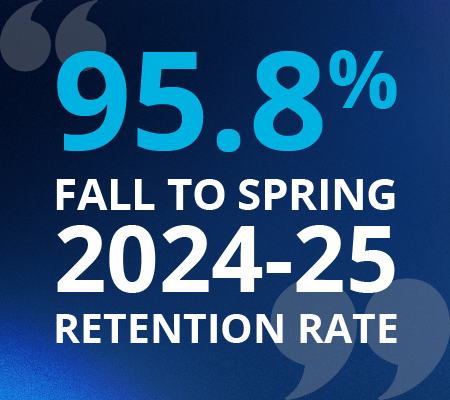
UNF now operates with a culture of proactive care. Staff and faculty increasingly share a common vocabulary, and the University’s commitment to student success is visible across campus. Cross-departmental meetings begin with student data. Staff contributions to student success are recognized and celebrated regularly. Leaders at every level are held accountable for results. Where silos predominated, departments are collaborating to reduce barriers and improve UNF’s student experience. The results are clear:
- First-Year Retention: 10% increase in five years.
- Fall-to-Spring Persistence: Reached an all-time high of 96.5%.
A MODEL FOR REPLICATION
UNF’s story is not one of a singular fix, but a systemic shift. It shows what is possible when student success is embedded in institutional DNA, when technology enables rather than impedes, and when policy aligns with purpose — at every level of the institution from president to provost to advisor.
What makes UNF’s strategy distinctive is its operational pragmatism, combined with cultural intentionality. We did not just ask what programs to build. We asked how every touchpoint, policy and communication either supports or distracts from our students' academic momentum.
UNF’s approach embraces continuous improvement, listening to students and staff and iterating fast. We believe this model — holistic, human-centered, accountable and powered by actionable data — offers a path forward not just for our institution, but for public universities nationwide wishing to achieve powerful results in short order.
As public institutions seek to fulfill their historic mission as engines of mobility, UNF offers a replicable playbook: Integrate support systems, center the human experience, trust the data, and above all, believe in your students’ potential. When public institutions succeed in helping students succeed, they elevate families, communities and entire regions. This is the promise of public higher education.
References
-
EAB. (2022). Rethinking the first year: How to design effective onboarding for first-generation students. Retrieved from https://eab.com
-
EAB. (2023). 3 reasons your early alert system isn’t working and how to fix it. Retrieved from https://eab.com
-
University Innovation Alliance (UIA). (2022). Predictive analytics and student success: Lessons from the field. Retrieved from https://theuia.org
- Updated April 2026